Thursday, September 10, 2015
Galileo! Galileo! Galileo now no more!


Tuesday, September 1, 2015
Galileo, Day 1: OK, now it gets good.
Finally, Salviati and Sagredo back Simplicio into a corner, reminding him of Aristotle's insistence that the evidence of the senses should take precedence over eloquent argument. I have two thoughts on this:
1) It is quite ironic that Aristotle's teachings were treated as dogma by subsequent generations who tried to suppress or disregard evidence of the senses in favor of Aristotle's eloquent arguments. This reminds me a bit of Hofstadter's final word on Dewey, whose disciples tried to institutionalize anti-institutional teaching methods.
2) If we told our students to trust their senses over even the most seemingly logical argument, we might persuade them that Newtonian mechanics is wrong (and not in the way that relativity and quantum mechanics disagree with Newtonian mechanics). A great many physicists, from a great many pedagogical schools, have noted that when you grow up in a world with friction, air resistance, and gravity, and where most physical objects have substantial moments of inertia (i.e. they can't be treated as gravity), the abstractions of Newtonian mechanics make precious little sense. We don't have point objects. We don't have frictionless surfaces. We can't really conceive of motion "in the absence of an applied force" because real objects either slow down while moving on the ground if you don't push them, or fall if you let go of them.
Moreover, the known inadequacies of freshman lab equipment once led the great teacher and author David Griffiths to make this statement:
I can explain the conservation of momentum in 15 minutes, but three hours in the lab would only convince an honest student that the law is false.If the question is what we should do about this in the classroom, the answer is that we should do Newtonian mechanics experiments on air tables with digital timers and photogates. However, the bigger point here is that many fallacies are rooted in real observations, and it isn't always obvious how un-systematic those observations are. Short of a really, really good experimental investigation of Newtonian mechanics, one will almost certainly be solving mechanics problems on the basis of logical argument rather than the observations of one's own senses. Ironic, no? And that's not just true of Newtonian mechanics (where, in principle, a university could get some really, really good freshman lab equipment and really take the time to....HA HA HA HA HA, I made a good joke there, didn't I?), it's even more true of other branches of science. None of us will ever personally observe, let alone conduct, more than a tiny fraction of the experiments needed to establish the foundations of our branches of science.
Galileo on Aristotle
I am a third of the way through the first of the four dialogues. It consists largely of showing how cumbersome and inconsistent Aristotelian physics is. It is a hard slog. We owe Galileo a debt for taking down Aristotle, cleaning the slate, and then starting to fill it in with new physics so that Newton could complete mechanics.
There is a little bit of actual physics. Early in this part of the book (page 26) Salviati uses ideas equivalent to energy conservation on the inclined plane, and Sagredo readily agreed without demanding experimental proof. Then they segue to other topics. I think they return to it in a subsequent dialogue.
Sunday, August 30, 2015
I am triggered by people who fear books and speech
(Oh, and before you tell me that when I question trigger warnings I'm being insensitive to people with PTSD, I will refer you to an article by a psychiatrist finishing her residency. The rhetoric from the pro-trigger camp does not match the clinical reality of PTSD.)
That said, the problem is not one of numbers but rather the powers available to a minority of whiners and the ass-covering tendencies of those in power. For instance, Laura Kipnis: I disagree with a great many things that Kipnis said in her controversial March essay. I have no particular desire to defend what she said. I think she has a blinkered view of what can go wrong in sexual relationships between people on different rungs of the same hierarchy, and I would not want to translate her views into policy in any institution that I would be affiliated with.
So what? She still has the right to say it, and the mere fact that she is wrong does not make her dangerous to individual health and well-being. There was no reason to drag her though a Title IX investigation for a mere article. It might be dangerous to an institution if her views were turned into policy, but I hear all sorts of dumb ideas in meetings, ideas that would probably be horrible for the institution if translated into policy. Merely mentioning those ideas is not the sort of danger from which I am entitled to some sort of protection, and we don't drag people in front of an investigator for airing those ideas in meetings. The only harm that they might do by merely speaking is to elevate my blood pressure, and my institution already provides me with health insurance to cover my stress tests and headache medication. If I wish to defend myself from more than speech, and work against the implementation of those ideas, it is my responsibility to get involved in institutional governance, and so I do. Given this distinction between speech and action, it is inexcusable that Kipnis was dragged through a Kafkaesque bureaucracy (at great excuse to the institution) just because some whiners complained that her column made them feel unsafe. Unsafe? Because of a column in the Chronicle? I cannot think of a more benign venue in which to publish! (Indeed, I have published my own bit of heresy there.) And then the same process was inflicted on an academic Senator who spoke in her defense? This is not the creation of a supportive environment for victims of assault and harassment.
If it were just one person being dragged before one investigator because of one institution gone a bit silly, well, lots of really bad things happen, but not all of them are trends. What makes me take this latest wave a bit more seriously is that a vocal minority can effect policy. For instance, why would the student government at UCSB (the school from which I got my PhD, a school that I dearly love) pass resolutions for trigger warnings? Are they that fragile? Now, I can assure you that your average UCSB student is NOT lobbying for trigger warnings. They're too busy partying and surfing. However, it appears that among those with political skills and ambitions, the neo-Victorian influence is significant. I don't fear the average undergrad, but I do fear movements with talented organizers.
For that matter, while I actually think there are some good guidelines in these documents (e.g. don't make assumptions about people's backgrounds), I am disturbed by some of the guidelines that go to expression of personal opinion rather than false assumptions about other people. In particular, the document urges people to not call America "The land of opportunity." Now, I agree there are enough injustices in the US to merit a rebuttal to "land of opportunity" statements. At the same time, I know that there are reasonable and informed people who have nonetheless offered statements like that in the course of their academic duties. Not too long ago I was in a presentation by a business professor who is a woman of color (i.e. not a person who is unaffected by discrimination) and she said something similar in the context of the climate for entrepreneurship in the US. Now, perhaps you disagree with her. Perhaps you even have an evidence-based case for disagreeing with her (e.g. an analysis of data on class mobility). You should make that case. You should challenge her. You should debate with her. But she should not be judged guilty of some sort of harm to others merely for offering that controversial opinion.
Again, academia is not crawling with people looking to ruin the career of anyone who says "land of opportunity." We don't have to keep AAUP Committee A on speed-dial in our daily work. But it is disconcerting that when the touchy types show up they aren't always mere shouters on Twitter. (Seriously, stay away from Twitter. 140 characters aren't conducive to intellectual discourse.) Rather, they are often close to levers of power. That should frighten us. That should move us to speak passionately and defiantly and under our real names.
What prompted me to write this long post full of ire? This morning I read an op-ed co-authored by the President of Northwestern University, Morton Schapiro. He wrote in defense of the millenials calling for greater sensitivity. I will state up front that I personally respect him. Although I have never met him, when I was an undergraduate at USC he was the Dean of Letters, Arts, and Sciences, and it was well known that he taught a freshman GE course. I greatly admired that even then, and as I have gone on in higher ed I have come to appreciate how rare it is for the people on the higher rungs to keep a foot in the classroom, and hence maintain first-hand exposure to what is actually happening. So I admire him as a person. I will even go so far as to say that he has good points about millenials pushing for people to be more respectful in their interactions with others. However, when these respectable impulses for inclusion morph into fear of speech, and even calls for censorship, they go too far.
But why am I singling him out when this matter has been discussed by a great many people? Because he's the President of Northwestern, the same school that dragged Laura Kipnis through an inexcusable process and then tried to censor a journal issue on bioethics edited by Alice Dreger, a former Northwestern faculty member who resigned in protest. It is clear that Northwestern has a beam in its eye on the matter of free speech, and yet it is trying to point to the speck in other people's discourses. (And, yes, I just quoted another book that people have tried to ban.) Go ahead and consider the valid points made in that op-ed, but don't forget that it is something of a smoke screen.
Next Book: Dialogue concerning the two chief world systems
The "two cultures" problem of the academic world, in which it is considered barbaric to have no interest in art or literature or history but quite acceptable to laugh and say "Yeah, I never got math or science", is well-illustrated by Galileo's position in the Western canon, or perhaps his lack of a position in the Western canon. Every educated person knows his name and a few anecdotes (and probably apocryphal anecdotes) but there are far more educated people who have read Plato than have read Galileo. (For the record, I've read Plato's Symposium and the Republic.) This is a strange thing when you consider that our modern view of the universe owes so much to him, and that Galileo's view of the relationship between science and religion remains controversial (to both secularists and believers) in the modern world, yet is also an apt description of the views of many of the religious believers working in the sciences today. It is strange that the writings of such a pivotal figure in the development of modern science and Western culture are not nearly as widely-studied as those of Western thinkers outside the sciences.
Friday, August 28, 2015
The Journals of Irreproducible Results
A group of psychologists recently attempted to replicate 100 studies published in psychology journals in 2008. The results are in, and they aren't great. Roughly a third of results were replicated at a statistically significant level. Before I unpack some of the implications, I should put in an important qualifier, namely that this does not mean that those studies should not have been published or that the investigators did something wrong! A study isn't conducted and published in order to provide the final word, but rather to invite the rest of the community to scrutinize the work and attempt to replicate it. If a conscientiously-conducted and well-designed experiment gives a statistically significant result (positive or negative), that result is fair game for dissemination, discussion, and further scrutiny. This replication effort is not evidence that science is not being done, but rather evidence that science is being done right. We need more replication efforts, not fewer studies.
That said, it should give pause to people who point to a study and make prescriptions. I've written before about the cult of This One Study, and the challenges of actually reproducing so many psychology studies point up the follies of that cult. Moreover, as challenging as it is to get reproducible results in psychology, many educational research studies that I read do an even worse job on blinding participants and maintaining proper controls, Some of that is inevitable, given the nature of classroom work, but some of it is a result of people uncaringly playing with too many variables at once. If the person teaching the class is enthused about trying a new educational method and transmits that enthusiasm, and also varies the topics and assignments, while the person in the "control" group is not doing anything to get fired up and refreshed, you can't treat this as a single-variable experiment. Moreover, often educational experiments are tapping into deep wells of cultural baggage; will the experiment get the same effect if it is conducted with people from the opposite side of that cultural divide? Finally, it has been pointed out to me by at least one person trained in statistics and educational psychology that when you have one class section taught by New Method and another class section taught by Old Method, even if you have hundreds of students in each section you still have n=1 in the experimental and control groups, not n=hundreds, if your goal is to study methods rather than students. "n=1" is a fancy statistical term for "anecdote." Despite all of this, educational research tends to lead to a lot of teaching and prescription.
Strangely enough (or maybe not strangely at all, depending on your degree of cynicism), I suspect that Right-Thinking People will delightedly cite this finding that psychology experiments are not always reproducible as a way of reminding people that they don't necessarily know what they think they know, but will also continue to cite their favorite studies as rhetorical cudgels. Consistency conshmistency!
Monday, August 24, 2015
Surprising data on student loans
Big mistake.
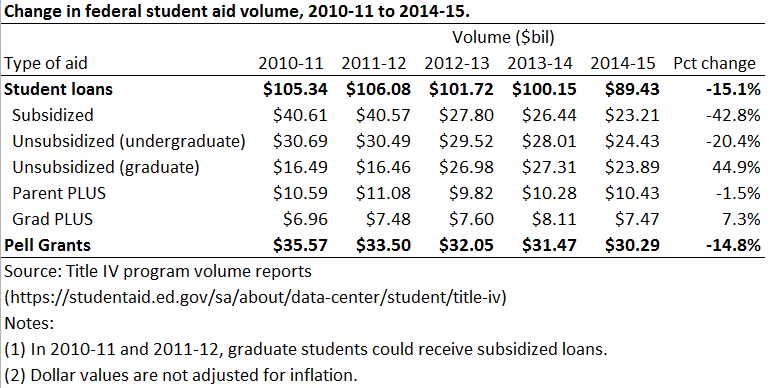
Via Matt Reed, I learned of an analysis by higher education policy analyst Robert Kelchen, who used data from the Department of Education to show that the annual rate of borrowing for undergraduate education (whether subsidized loans, unsubsidized loans, or parental loans) has been decreasing, even as the amount of Pell grants given out has gone down and state legislatures have proven reluctant to hike higher ed spending.